Current reality: September 2026
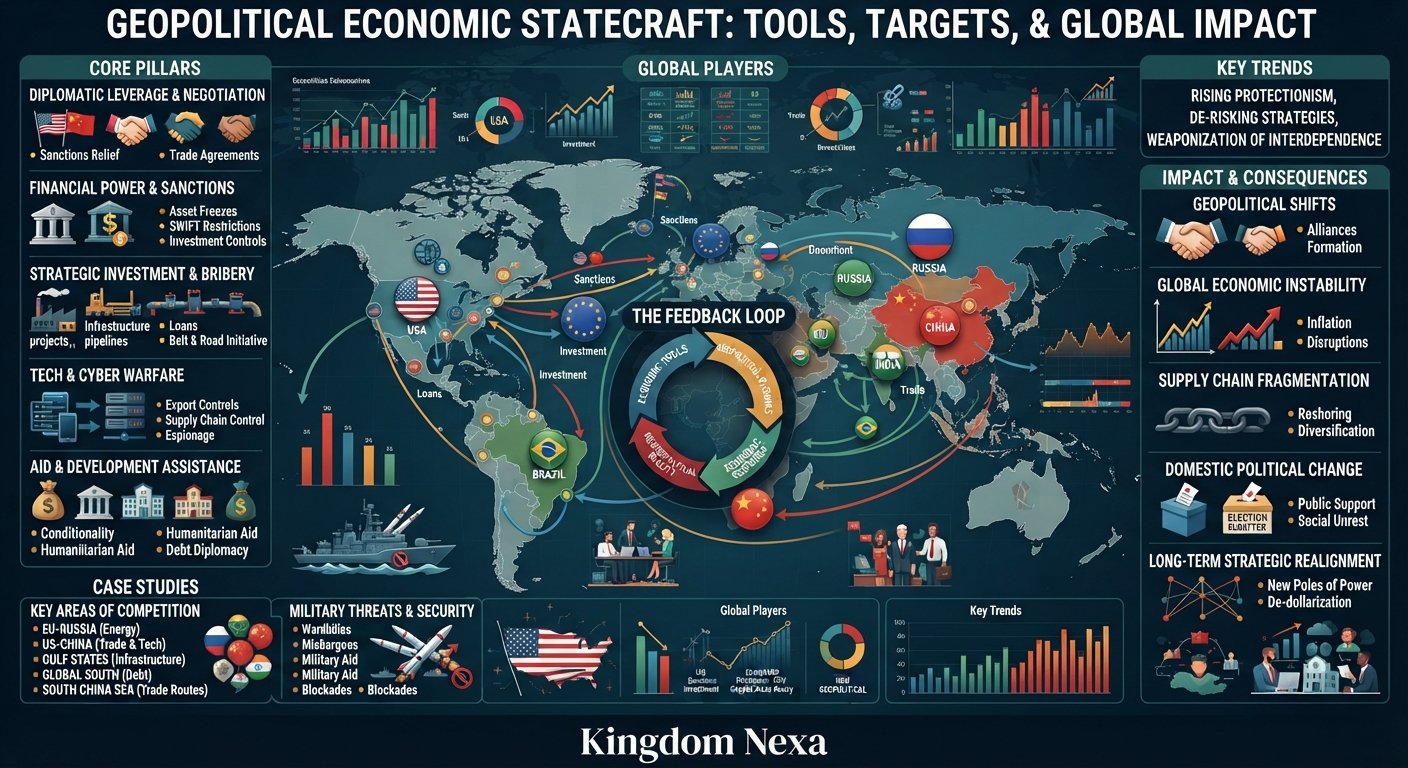
Economic power has become one of the most important instruments of international politics. Governments can now influence foreign-policy outcomes without deploying troops by restricting market access, freezing assets, controlling technology exports, offering loans, building infrastructure, imposing tariffs, regulating investment, or controlling access to critical resources.
This broader practice is known as Economic Statecraft.
The concept is not new. The Marshall Plan, oil embargoes, Cold War trade restrictions, development finance, and international financial institutions all demonstrate how economic relationships can shape geopolitical behavior. What has changed is the scale and sophistication of these instruments. In 2026, economic statecraft increasingly reaches into semiconductors, artificial intelligence, financial networks, critical minerals, supply chains, digital infrastructure, investment screening, and energy security.


What Is Economic Statecraft?
Economic statecraft is the use of economic resources, relationships, and policies by governments to pursue foreign-policy, national-security, diplomatic, or geopolitical objectives.
It can be coercive, such as sanctions and export controls, or inducive, such as foreign aid, preferential trade agreements, investment, loans, and development partnerships.
The Council on Foreign Relations describes economic statecraft as the use of tools including lending, foreign assistance, sanctions, and trade agreements to advance foreign-policy priorities. (Council on Foreign Relations)
The central idea is straightforward: economic dependence can create political leverage.
A state that controls an important market, financial system, technology, commodity, shipping route, or supply chain may possess influence beyond the size of its military.
Economic Statecraft vs. Geoeconomics
The terms are closely related but not identical.
Geoeconomics examines how economic instruments and relationships interact with geopolitical power. Economic statecraft focuses more specifically on governments deliberately using economic instruments to achieve strategic objectives.
For example:
- A country studying its dependence on imported semiconductors is examining a geoeconomic vulnerability.
- A government restricting semiconductor exports to a rival for national-security reasons is practicing economic statecraft.
- A government subsidizing domestic semiconductor production to reduce that vulnerability is also using economic statecraft.
This distinction matters because modern geopolitical competition increasingly operates through the economic system itself.
How Economic Statecraft Developed
Economic statecraft has deep historical roots, although its instruments have changed considerably.
The Marshall Plan and Economic Attraction
After the Second World War, the United States used economic assistance as part of its broader strategy toward Europe.
The Marshall Plan, formally the European Recovery Program, provided billions of dollars in assistance to European countries beginning in 1948. The program supported reconstruction while also helping create stronger economic relationships between the United States and Western Europe. (Office of the Historian)
This illustrates an important feature of economic statecraft: economic influence does not necessarily depend on punishment.
Aid, investment, reconstruction finance, trade preferences, and technical assistance can create partnerships and increase political alignment.
Bretton Woods and Institutional Power
The 1944 Bretton Woods Conference created the foundations for the postwar international monetary system and established the IMF and International Bank for Reconstruction and Development, now part of the World Bank Group. (IMF)
These institutions were not simply instruments of coercion. Their formal purposes include monetary cooperation, financial stability, development, and economic growth. Nevertheless, international institutions can also shape the rules, incentives, and relationships through which states exercise economic influence.
The IMF, for example, provides financing to members facing balance-of-payments problems, while the World Bank provides financing, policy advice, and technical assistance for development. (World Bank)
Embargoes and Resource Power
The 1973–74 oil embargo demonstrated another dimension of economic statecraft: the strategic power of resource dependence.
During the Arab-Israeli War, Arab OPEC members imposed an oil embargo on the United States and some other countries, while production cuts contributed to a sharp increase in global oil prices. The episode exposed the geopolitical consequences of dependence on strategically important commodities. (Office of the Historian)
The lesson remains relevant today: whoever controls a strategically important bottleneck can acquire influence over those who depend upon it.
What Are the Main Tools of Economic Statecraft?
Economic statecraft is best understood as a toolkit rather than a single policy.
Sanctions
Sanctions restrict economic or financial relationships with targeted states, companies, organizations, or individuals.
They can involve:
- Asset freezes
- Financial restrictions
- Trade bans
- Investment restrictions
- Travel restrictions
- Commodity restrictions
- Restrictions on specific technologies
- Restrictions on financial institutions
The United Nations Security Council can impose sanctions under Article 41 of the UN Charter without using armed force. UN sanctions have included comprehensive economic restrictions as well as targeted financial, commodity, travel, and arms measures. (United Nations)
Many governments also maintain unilateral or coalition-based sanctions regimes.
Sanctions therefore differ significantly in legal basis, scope, enforcement, and international legitimacy.
Tariffs and Trade Restrictions
Tariffs can serve ordinary economic objectives, but they can also become instruments of geopolitical bargaining.
Trade restrictions can:
- Increase the cost of imports
- Protect strategic industries
- Reduce dependence on foreign suppliers
- Pressure another government
- Encourage supply-chain relocation
- Respond to perceived unfair trade practices
The WTO monitors trade measures worldwide and maintains data on tariffs and other trade-related restrictions. Its 2025 monitoring reported a major increase in the value of global imports affected by new tariffs and other import measures during the preceding reporting period. (World Trade Organization)
Trade policy therefore increasingly overlaps with national-security policy.
Export Controls
Export controls restrict access to strategically important goods, technologies, software, equipment, or knowledge.
They have become particularly important in:
- Advanced semiconductors
- Semiconductor manufacturing equipment
- Artificial intelligence
- High-performance computing
- Aerospace
- Dual-use technologies
- Cybersecurity
- Advanced manufacturing
The United States has repeatedly updated controls on advanced semiconductor technologies involving China. In January 2026, the U.S. Bureau of Industry and Security revised its licensing policy for certain advanced chips exported to China, moving toward case-by-case review subject to specified security requirements.
This illustrates an important characteristic of contemporary economic statecraft: technology itself has become a strategic asset.
Investment Screening
Foreign investment can create economic benefits while also raising national-security concerns.
Governments increasingly examine whether foreign acquisitions could provide access to:
- Critical infrastructure
- Sensitive technologies
- Defense-related capabilities
- Strategic data
- Telecommunications networks
- Energy systems
- Critical supply chains
The European Union has strengthened its investment-screening framework. In December 2025, EU institutions reached a political agreement on a revised system intended to make investment screening more consistent and comprehensive across member states. (Trade and Economic Security)
Financial Power
Financial infrastructure can create significant geopolitical leverage.
Important instruments include:
- Access to banking systems
- Restrictions on correspondent banking
- Asset freezes
- Sovereign financing
- Development loans
- Payment networks
- Currency relationships
- Capital-market access
Financial statecraft can be especially powerful because modern economies depend heavily on cross-border payments and financial intermediation.
Foreign Aid and Development Finance
Economic statecraft can also operate through positive incentives.
Governments may provide:
- Development assistance
- Budgetary support
- Infrastructure financing
- Export credits
- Investment guarantees
- Disaster assistance
- Technical cooperation
Such measures can strengthen diplomatic relationships and create long-term economic partnerships.
The Marshall Plan remains one of the clearest historical examples of economic assistance being connected to wider strategic objectives. (Office of the Historian)
Why Is Economic Statecraft Becoming More Important?
Several developments are increasing its importance.
Globalization Created Strategic Dependencies
Modern economies depend on international supply chains.
A country may manufacture a final product domestically while depending on foreign suppliers for:
- Minerals
- Components
- Machinery
- Software
- Energy
- Financial services
- Transportation
- Specialized technologies
This creates what can be called interdependence vulnerability.
Interdependence can generate prosperity, but it can also create leverage.
The IMF has highlighted this trade-off: specialization and global economic integration create efficiency gains while simultaneously producing dependencies that can become vulnerabilities during geopolitical conflict. (IMF)
Technology Has Become a Security Domain
The strategic importance of advanced technologies has transformed export controls from relatively specialized trade measures into major instruments of national security.
The semiconductor industry provides a clear example.
Advanced chips support artificial intelligence, telecommunications, high-performance computing, and sophisticated military systems. As a result, governments increasingly consider semiconductor supply chains part of strategic security.
U.S. controls introduced or expanded in recent years have targeted advanced computing chips, semiconductor manufacturing equipment, high-bandwidth memory, and related technologies.
Critical Minerals Are Strategic Assets
Critical minerals demonstrate another major shift.
Lithium, cobalt, nickel, graphite, rare earth elements, and other materials are important for batteries, electronics, renewable-energy technologies, advanced manufacturing, and defense.
The OECD’s 2026 inventory found that restrictions on critical raw materials remained at historically high levels. Between 2022 and 2024, approximately 16% of monitored global trade in critical raw materials faced at least one export restriction; exposure was particularly high for cobalt, manganese, graphite, and rare earth elements. (OECD)
For governments, the strategic question is no longer simply whether resources exist. It is who controls extraction, processing, transportation, technology, and market access.
Economic Statecraft in Current Geopolitics
The most visible contemporary example is the extensive use of economic measures surrounding Russia’s war against Ukraine.
The European Union has progressively expanded restrictions involving finance, energy, trade, technology, shipping, and military-industrial supply chains.
In July 2026, the EU adopted its 21st sanctions package against Russia. The measures included additional restrictions involving financial institutions, crypto-related services, energy, the shadow fleet, dual-use goods, and military-industrial capabilities. (Consilium)
In September 2026, the EU extended individual restrictive measures connected to Ukraine’s territorial integrity for another three years, with measures including asset freezes and prohibitions on making funds or economic resources available to designated individuals and entities. (Consilium)
These measures illustrate how economic statecraft increasingly combines several instruments rather than relying on a single embargo.
Economic Statecraft and the United States-China Relationship
The U.S.-China relationship demonstrates another dimension: strategic competition over technology and industrial capacity.
Semiconductor export controls, investment restrictions, industrial subsidies, supply-chain diversification, and technology protection are increasingly connected to national-security policy.
However, economic statecraft does not eliminate interdependence. China remains deeply integrated into global manufacturing and supply chains, while U.S. firms and consumers remain connected to Chinese production and markets.
The result is not simply economic separation. It is a more complicated process involving selective decoupling, de-risking, diversification, and technological competition.
Who Uses Economic Statecraft?
Economic statecraft is not limited to major powers.
Major Powers
The United States, China, the European Union, Russia, Japan, India, and other major economies possess substantial economic tools because of their market size, financial systems, technology sectors, resources, or trading relationships.
Middle Powers
Middle powers can also gain leverage through:
- Strategic commodities
- Geographic location
- Port infrastructure
- Energy transit
- Specialized industries
- Diplomatic coalitions
A country does not necessarily need a massive economy to exercise economic statecraft.
International Organizations
The UN, IMF, World Bank, WTO, regional development banks, and other institutions influence the economic environment in which states operate.
UN Security Council sanctions are particularly distinctive because member states are responsible for implementing measures adopted under the Council’s authority. (United Nations)
Corporations
Multinational companies are increasingly relevant because governments depend on private firms to implement many economic restrictions.
Banks, technology companies, shipping firms, insurers, manufacturers, and commodity traders can determine whether a policy actually reaches its intended target.
This makes compliance and corporate risk management important components of modern economic statecraft.
What Are the Risks and Limitations?
Economic statecraft is powerful, but it is not automatically effective.
Sanctions Can Produce Unintended Effects
Restrictions can affect ordinary consumers, third-country companies, humanitarian activities, and global markets.
Targets may attempt to:
- Find alternative suppliers
- Develop domestic substitutes
- Redirect trade
- Use intermediary countries
- Create alternative payment mechanisms
- Develop new technologies
The effectiveness of a measure therefore depends partly on how easily the targeted country can adapt.
Economic Pressure Can Accelerate Fragmentation
If several major economies create competing technology, payment, trade, and supply-chain ecosystems, global economic fragmentation can increase.
The IMF has warned that geoeconomic fragmentation can reduce some of the efficiency gains associated with specialization and expose countries to higher costs and supply vulnerabilities. (IMF)
Coercion Can Encourage Countermeasures
One state’s restrictions can motivate another to respond with:
- Export controls
- Tariffs
- Investment restrictions
- Resource restrictions
- Domestic subsidies
- Alternative financial systems
Critical minerals provide a particularly clear example of this dynamic. OECD research shows that export restrictions have increased substantially over the past 15 years and can generate negative spillovers across global supply chains. (OECD)
Legal and Diplomatic Constraints Matter
Economic statecraft does not operate outside international law.
Trade measures can raise questions under WTO rules. Sanctions can raise questions concerning jurisdiction, due process, humanitarian exemptions, and the legal authority under which they are imposed.
UN sanctions have a distinct legal basis under Chapter VII, while unilateral sanctions may rest on domestic legislation and differ substantially in their international legal treatment.
What Does Economic Statecraft Mean for Developing Countries?
Developing and emerging economies face a complicated position.
They can become targets of economic pressure, but they can also gain bargaining power because of:
- Natural resources
- Labor markets
- Manufacturing capacity
- Geographic position
- Ports
- Energy corridors
- Agricultural exports
The challenge is avoiding excessive dependence on any single major power.
Diversification can increase strategic autonomy, but it can also be expensive. Building alternative supply chains, domestic industries, ports, energy systems, or technology capabilities requires capital and time.
For many countries, the practical strategy is therefore not complete economic independence but greater resilience and diversified partnerships.
What Comes Next for Economic Statecraft?
Several trends are likely to shape the next phase.
From Sanctions to Integrated Economic Security
Governments are increasingly combining sanctions, export controls, investment screening, industrial policy, supply-chain policy, and critical-resource strategies.
The distinction between economic policy and national-security policy is consequently becoming less clear.
Technology Will Remain Central
AI, semiconductors, quantum technologies, advanced telecommunications, cybersecurity, and satellite systems are likely to remain areas where commercial and military interests overlap.
Supply Chains Will Become Strategic Infrastructure
Critical minerals, energy infrastructure, shipping networks, data centers, undersea cables, ports, and logistics systems are increasingly viewed through a security lens.
Economic Influence Will Become More Competitive
The emerging environment is unlikely to be defined simply by one country controlling the global economy. Instead, different states possess different forms of leverage.
One may control financial infrastructure. Another may dominate manufacturing. It may possess critical minerals. Another may control an important geographic corridor.
This creates a more complex form of geoeconomic competition.
Frequently Asked Questions About Economic Statecraft
What is economic statecraft in simple terms?
Economic statecraft is the use of economic tools by governments to achieve foreign-policy or national-security objectives. These tools include sanctions, trade restrictions, financial measures, aid, investment, and technology controls.
What are the main tools of economic statecraft?
The main tools include sanctions, tariffs, export controls, import restrictions, foreign aid, development finance, investment screening, subsidies, financial restrictions, and control over strategic resources.
Is economic statecraft always coercive?
No. Economic statecraft can involve both coercion and incentives. Sanctions are coercive, while aid, investment, loans, trade preferences, and development partnerships can encourage cooperation.
How is economic statecraft different from sanctions?
Sanctions are one component of economic statecraft. Economic statecraft is broader and includes both restrictive and positive economic instruments.
Why are semiconductors important to economic statecraft?
Advanced semiconductors support AI, computing, communications, and many military capabilities. Their strategic importance has encouraged governments to use export controls and industrial policies to protect or develop technological advantages.
Why are critical minerals part of economic statecraft?
Critical minerals are essential for batteries, electronics, renewable-energy technologies, advanced manufacturing, and defense. Countries that control significant extraction or processing capacity can therefore possess important economic leverage.
Can economic statecraft replace military power?
Not generally. Economic tools can impose costs, create incentives, constrain capabilities, or support diplomacy, but their effectiveness depends on circumstances. Military, diplomatic, technological, and economic capabilities often operate together.
Can economic statecraft harm the country using it?
Yes. Trade restrictions and sanctions can raise costs for domestic businesses and consumers, disrupt supply chains, reduce export opportunities, and encourage targeted countries to develop alternatives.
Why is economic statecraft increasingly important in 2026?
Global supply-chain dependence, strategic technology competition, critical-mineral concentration, financial interdependence, and geopolitical rivalry have made economic relationships increasingly important to national security.
Conclusion
Economic statecraft has evolved from traditional trade pressure and financial restrictions into a much broader instrument of geopolitical competition. Governments now use market access, sanctions, investment, technology controls, development finance, industrial policy, critical minerals, and financial infrastructure to pursue strategic objectives.
The defining feature of the current environment is interdependence. Countries need one another economically, yet those same dependencies can create vulnerabilities.
The contemporary challenge is therefore not simply determining who possesses the largest economy. It is understanding who controls critical technologies, financial channels, resources, supply chains, markets, infrastructure, and standards—and how those forms of leverage can be converted into geopolitical influence.
As economic security becomes increasingly integrated with national security, understanding economic statecraft is essential for interpreting international relations, great-power competition, trade policy, sanctions, technological rivalry, and the evolving global order.