Global politics is entering a period in which military strength, economic influence, technological leadership, resource security, and diplomatic relationships are becoming increasingly interconnected. Decisions made in Washington, Beijing, Moscow, Brussels, New Delhi, and other major centers of power can influence energy prices, international trade, regional conflicts, investment decisions, and national security far beyond their immediate borders.
Understanding Global Strategic Trends is therefore essential for anyone seeking to understand how the international system is changing and what these transformations mean for the future. Traditional measures of power remain important, but they no longer tell the entire story. Artificial intelligence, semiconductor supply chains, critical minerals, cyber capabilities, demographic change, climate pressures, and the strategic choices of middle powers are also shaping international competition.
As of October 2026, the emerging picture is neither a simple transition to a new Cold War nor a straightforward movement toward a stable multipolar order. Instead, states are competing intensely in some areas while maintaining economic relationships and cooperating on selected global challenges in others. The result is a more complex strategic environment, characterized by uncertainty, selective cooperation, and shifting alignments.
This article examines the principal forces reshaping global affairs, explains why they matter, and assesses plausible developments that could influence international security, economic stability, and the balance of power in the years ahead.
What Are Global Strategic Trends?
Global strategic trends are long-term changes in political power, economic relationships, military capabilities, technology, society, and the environment that influence how countries pursue their interests and interact with one another.
They differ from individual news events because they develop over time and can alter the conditions under which governments make decisions. A diplomatic dispute may last several weeks, for example, while a sustained shift in technological leadership can influence international relations for decades.
These trends operate at several interconnected levels:
- Global: Changes in the distribution of power, international institutions, and worldwide economic relationships.
- Regional: Shifts in security arrangements, trade networks, and political influence within regions.
- National: Changes in domestic political priorities, industrial policy, military planning, and economic resilience.
- Transnational: Challenges such as cybercrime, climate change, pandemics, migration, and technological disruption that cross national borders.
Their importance lies in their interaction. Technological competition can influence trade restrictions; trade restrictions can reshape alliances; security concerns can accelerate military spending; and climate pressures can intensify competition over water, food, and energy.
Consequently, strategic analysis must examine not only what is changing, but also the causes, constraints, and consequences of those changes.
1. The Shift Toward a More Multipolar World
One of the most consequential developments is the growing diffusion of international influence among established powers, rising economies, regional powers, and increasingly capable non-state actors.
The United States remains a central military, financial, technological, and diplomatic power. China has become a major economic and technological competitor, while Russia continues to exert significant military influence. The European Union, India, Japan, Türkiye, Saudi Arabia, Brazil, and other states also shape international outcomes in different ways.
However, multipolarity does not mean that all countries possess equal influence. Power remains unevenly distributed, and the United States and China retain advantages that few other states can match across multiple domains.
Why the balance of power is changing
Several developments are contributing to this transformation:
- The expansion of Asian economies and technological capabilities.
- Greater diplomatic activity by middle powers.
- Efforts by governments to reduce strategic dependence on individual suppliers or markets.
- The growing importance of regional institutions and partnerships.
- The ability of smaller states to influence outcomes through geography, resources, specialized technology, or diplomatic mediation.
The 2026 Strategic Trends assessment by ETH Zurich’s Center for Security Studies describes a global environment marked by shifting power balances, increasing rivalry, and fragmentation, alongside greater agency for smaller and middle powers.
Strategic implications
A more distributed international system creates opportunities for states to diversify partnerships and negotiate better terms. However, it also complicates collective action when major powers disagree over security, trade, or international rules.
For developing countries, the challenge is to gain investment, technology, and market access without becoming excessively dependent on one strategic partner. For major powers, maintaining influence increasingly requires economic competitiveness, diplomatic credibility, and reliable partnerships—not military capability alone.
Multipolarity is therefore best understood as an evolving distribution of influence rather than a completed transition to a settled new world order.
2. Intensifying Great-Power Competition
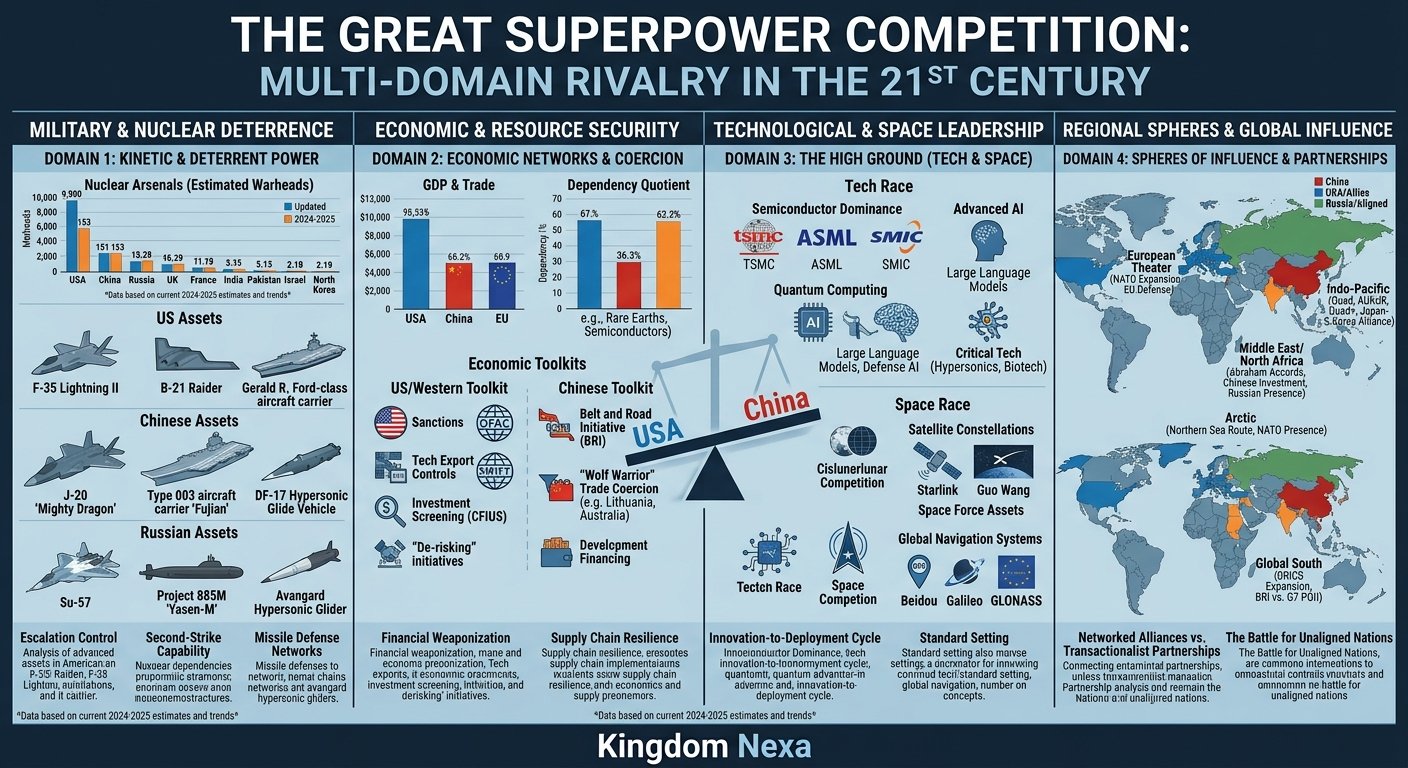
Competition between the United States and China is a defining feature of contemporary geopolitics. It encompasses trade, advanced manufacturing, artificial intelligence, semiconductors, military posture, maritime access, diplomatic influence, and competing visions of international governance.
Russia’s confrontation with Western countries, including over European security and the war in Ukraine, adds another major dimension to the strategic environment. Meanwhile, European governments are reassessing defense capabilities, industrial resilience, and their relationships with both Washington and Beijing.
Competition extends beyond military power
Modern strategic rivalry increasingly involves the ability to control or access critical technologies, financial systems, energy supplies, communications networks, and industrial capacity.
Export controls, investment screening, sanctions, tariffs, and industrial subsidies have become important instruments of statecraft. These measures may serve national security objectives, but they can also increase costs for businesses, disrupt supply chains, and provoke retaliatory action.
The World Economic Forum’s Global Risks Report 2026 identifies geoeconomic confrontation as a leading near-term global risk, reflecting concerns about the use of economic relationships as instruments of strategic competition.
The danger of miscalculation
Intense competition does not make direct conflict inevitable. Economic interdependence, nuclear deterrence, domestic priorities, and the potentially enormous costs of war can constrain escalation.
Nevertheless, military encounters, disputed maritime claims, cyber incidents, and conflicting interpretations of deterrence can create pathways to crisis. Reliable communication channels, crisis-management mechanisms, and clear signaling remain essential.
The central strategic question is whether major powers can compete while maintaining sufficient restraint to prevent rivalry from escalating into a wider conflict.
3. Economic Fragmentation and the Geopolitics of Trade
Globalization is changing rather than simply disappearing. International commerce remains extensive, but governments and companies increasingly consider political risk, national security, and supply-chain resilience alongside cost and efficiency.
This shift is often described as geoeconomic fragmentation: the restructuring of economic relationships under the influence of geopolitical competition.
UN Trade and Development’s January 2026 assessment reported that preliminary estimates indicated global trade exceeded $35 trillion in 2025, an increase of approximately 7%. It also warned that slower growth, protectionism, changing value chains, and tighter regulations were reshaping trade in 2026.
Why supply chains are becoming strategic assets
Industries such as semiconductors, pharmaceuticals, telecommunications, batteries, and defense manufacturing depend on complex networks spanning multiple countries. Disruption at a single production stage can affect industries worldwide.
Governments are responding through several approaches:
- Reshoring: Bringing selected production activities back home.
- Nearshoring: Moving production closer to domestic markets.
- Friend-shoring: Expanding supply chains through politically trusted partners.
- Diversification: Reducing dependence on a single country, company, or transport route.
- Strategic stockpiling: Maintaining reserves of essential goods and materials.
These approaches can improve resilience, but they are not cost-free. Duplicating factories, changing suppliers, and subsidizing domestic production may increase prices or reduce efficiency. Excessive restrictions can also fragment markets and slow innovation.
Implications for developing economies
Countries offering competitive labor, infrastructure, political stability, and access to major markets may attract investment as supply chains diversify. Yet opportunities are not automatic. Investors also consider electricity reliability, skills, logistics, regulatory predictability, and the risk of future trade restrictions.
The strategic challenge is to become a valuable part of international production networks without replacing one form of dependence with another.
4. Military Modernization and the Changing Nature of Warfare
Military power remains fundamental to deterrence, territorial defense, alliance commitments, and crisis bargaining. However, the character of military competition is changing as states integrate autonomous systems, precision weapons, satellite networks, cyber operations, and artificial intelligence into their defense planning.
The financial scale of this trend is significant. According to the Stockholm International Peace Research Institute (SIPRI), global military expenditure reached $2.887 trillion in 2025, rising 2.9% in real terms and marking the eleventh consecutive annual increase. Military spending represented approximately 2.5% of global GDP.
Key developments in military strategy
Uncrewed systems and precision weapons: Drones and relatively inexpensive uncrewed platforms can provide surveillance, targeting, and strike capabilities. Their growing use challenges traditional assumptions about the cost of air defense and battlefield superiority.
Cyber and electronic warfare: Attacks on networks, communications, and critical infrastructure can disrupt operations without conventional territorial occupation. Attribution and proportional responses remain difficult.
Space-based capabilities: Satellites support navigation, communications, missile warning, intelligence, and civilian services. Dependence on these systems creates new vulnerabilities and incentives to protect space infrastructure.
Artificial intelligence: AI can assist intelligence analysis, logistics, surveillance, and decision support. Its military use also raises questions about reliability, human control, escalation, and accountability.
Deterrence and escalation risks
Nuclear weapons continue to shape the strategic calculations of major powers. Conventional military expansion, missile defense, and long-range strike capabilities can affect perceptions of strategic stability, particularly when one state fears that its retaliatory capability is becoming vulnerable.
Military modernization may strengthen deterrence, but it can also fuel arms competition. The same technology that improves warning and targeting may compress decision-making time during a crisis.
Effective security planning therefore requires both credible defense capabilities and diplomatic arrangements that reduce the risk of accidental escalation.
5. Artificial Intelligence and Technological Sovereignty
Technology has become a central arena of global strategic competition. Advanced semiconductors, computing infrastructure, AI models, cloud services, telecommunications equipment, and digital platforms influence economic productivity as well as national security.
Technological leadership can provide commercial advantages, support military modernization, and strengthen diplomatic influence. Dependence on foreign suppliers, meanwhile, can create vulnerabilities during a political crisis.
The competition for AI leadership
The strategic value of artificial intelligence extends beyond chatbots and consumer applications. Governments and businesses are exploring its use in scientific research, manufacturing, logistics, cybersecurity, intelligence analysis, and public administration.
However, benefits depend on access to computing power, electricity, skilled workers, data, investment, and reliable infrastructure. The ability to develop advanced models is not the same as the ability to deploy them safely and productively across an entire economy.
The International Monetary Fund’s October 2026 World Economic Outlook projects global growth of 3.1% in 2026 and 3.4% in 2027, while identifying stronger AI investment and productivity gains as potential upside factors and a reassessment of AI expectations as a downside risk.
Digital sovereignty and international rules
Digital sovereignty refers to a government’s ability to control or protect important digital infrastructure, data, and technological capabilities within its jurisdiction.
Countries are pursuing this objective through domestic investment, data-protection laws, cybersecurity regulations, research funding, and technology partnerships. Yet complete technological independence is difficult because advanced systems rely on international supply chains and specialized expertise.
The likely strategic contest is therefore not simply between countries that develop technology and those that do not. It is also about who sets technical standards, controls key infrastructure, attracts talent, and shapes the rules governing technology’s use.
6. Energy Security and Competition for Critical Minerals
Energy remains a source of geopolitical influence, but the strategic landscape is expanding beyond oil and natural gas. Electricity networks, renewable technologies, battery manufacturing, nuclear energy, and critical minerals are increasingly important to national resilience.
The energy transition does not eliminate traditional energy geopolitics. Instead, it changes the resources, infrastructure, and supply chains on which states depend.
From oil and gas to minerals and electricity
Lithium, cobalt, nickel, copper, graphite, and rare earth elements are important to different technologies, including batteries, electric vehicles, power grids, electronics, and defense systems. Their significance varies by mineral and application.
Countries with substantial deposits, refining capacity, or advanced manufacturing industries can gain economic and strategic leverage. But geological resources alone do not guarantee influence: extraction costs, infrastructure, environmental standards, processing technology, and market concentration also matter.
The strategic importance of energy resilience
Import-dependent economies remain exposed to price shocks, shipping disruptions, and political disputes. Diversifying energy sources, improving efficiency, expanding electricity grids, and developing domestic or regional generation can reduce some vulnerabilities.
At the same time, poorly planned transitions can create new dependencies or leave countries with unreliable and expensive energy systems.
For policymakers, the objective is not merely to choose between fossil fuels and renewable energy. It is to build a secure, affordable, and adaptable energy system while managing emissions and protecting economic competitiveness.
7. Regional Powers and Middle-Power Diplomacy
The international system is shaped not only by great-power rivalry but also by countries that can influence particular regions, markets, institutions, or strategic corridors.
India, Türkiye, Saudi Arabia, Brazil, Indonesia, South Africa, and other regional or middle powers pursue foreign policies reflecting their own economic priorities, security concerns, and domestic political interests.
Strategic autonomy and diversified partnerships
Strategic autonomy means retaining the ability to make important national decisions without excessive dependence on a single external power. It does not necessarily require neutrality or equal distance from competing blocs.
India, for example, maintains important defense and economic relationships with Russia while expanding cooperation with the United States and other partners. European countries debate how to strengthen their own defense capabilities while preserving the transatlantic relationship. Gulf states pursue varied partnerships involving security, energy, investment, and technological development.
These approaches demonstrate that international alignment is often issue-specific rather than absolute.
Why middle powers matter
Middle powers can influence diplomacy by mediating disputes, facilitating trade, hosting negotiations, contributing to peacekeeping, or organizing coalitions around shared interests. Their leverage may come from geography, natural resources, industrial capacity, financial resources, or access to competing diplomatic networks.
However, balancing relationships is difficult when major powers demand clearer alignment. Smaller states may face pressure over defense cooperation, technology standards, sanctions, and access to strategic infrastructure.
The future of international politics will depend partly on whether these countries can preserve room for independent decisions while contributing to regional stability.
8. Regional Conflicts, Strategic Geography, and Maritime Security
Regional conflicts can have consequences far beyond the countries directly involved. They affect refugee movements, food security, energy markets, military deployments, diplomatic relationships, and the credibility of international institutions.
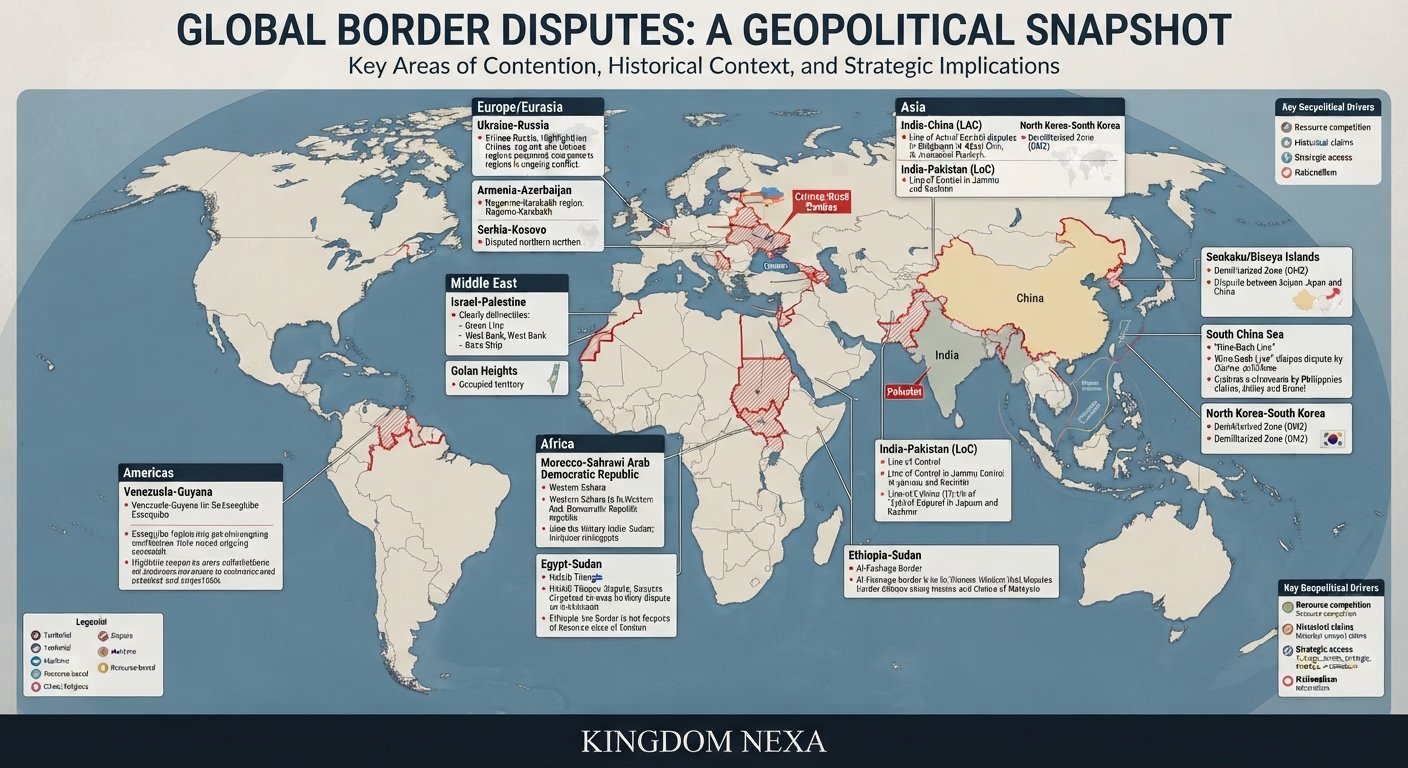
Three geographic areas illustrate why regional developments have global strategic significance.
Europe: Deterrence and continental security
Russia’s war against Ukraine has reshaped European defense planning, strengthened attention to military readiness, and intensified debates about the future of European security. NATO remains central to collective defense for its members, while European governments face difficult choices concerning defense expenditure, industrial capacity, and long-term support for Ukraine.
The wider challenge is to deter further aggression while preserving diplomatic channels that could eventually support a more stable security environment.
The Indo-Pacific: Maritime routes and strategic competition
The Indo-Pacific contains major manufacturing centers, vital shipping routes, and important technology supply chains. Competition involving China, the United States, India, Japan, Australia, and Southeast Asian states affects maritime security, regional partnerships, and the future of economic integration.
The Taiwan Strait and South China Sea are particularly significant because disputes there could disrupt trade and increase the risk of confrontation between major military powers.
Regional governments do not all share the same priorities. Some emphasize security cooperation; others prioritize economic relations with China or seek to avoid becoming entangled in great-power rivalry.
The Middle East: Energy, shipping, and regional security
The Middle East remains strategically important because of its energy resources, maritime chokepoints, regional rivalries, and connections to Europe, Asia, and Africa.
Instability affecting the Strait of Hormuz or Red Sea shipping routes can increase transport costs, disrupt deliveries, and influence energy prices. The effects depend on the duration and scale of disruption, available alternative routes, and market conditions.
Diplomacy, regional security arrangements, and protection of civilian populations remain essential to reducing the broader costs of conflict.
9. Climate Change, Water Stress, and Demographic Pressures
Environmental and demographic developments are increasingly relevant to national security. They can influence food production, migration, public finances, infrastructure investment, and political stability.
Climate change can increase exposure to extreme heat, floods, droughts, and coastal risks. The consequences are not uniform: vulnerability depends on geography, income, public institutions, infrastructure, and the ability to adapt.
Water and food security
Competition over shared rivers, groundwater, and agricultural resources can complicate relations between neighboring states. Water scarcity does not automatically produce conflict; agreements, joint infrastructure, data sharing, and effective domestic management can reduce tensions.
Food insecurity can similarly result from a combination of conflict, weather shocks, high prices, transport disruptions, and limited purchasing power. Import-dependent countries may be particularly vulnerable when several pressures occur simultaneously.
Demographic divergence
Some societies face aging populations and shrinking workforces, while others have large youth populations and rapidly growing cities. These differences affect labor markets, pension systems, education, migration, and military recruitment.
A young population can support economic growth when jobs, education, and infrastructure expand sufficiently. Without those opportunities, demographic growth can intensify unemployment and social frustration.
Climate and demographic pressures are therefore best understood as risk multipliers: they can worsen existing weaknesses, but their outcomes depend heavily on policy choices and institutional capacity.
10. Global Governance Under Pressure
International institutions were created to help states manage shared problems, coordinate policies, and reduce the costs of international instability. Their effectiveness now faces significant tests from strategic rivalry, competing national priorities, and disputes over representation.
The United Nations and international law
The United Nations provides a forum for diplomacy, humanitarian coordination, and international cooperation. The Security Council has primary responsibility for maintaining international peace and security, but the veto power of its five permanent members can constrain action when their interests conflict.
International law continues to provide important rules governing the use of force, armed conflict, state responsibility, diplomatic relations, and maritime activity. Enforcement, however, depends on a combination of institutions, state cooperation, and political circumstances.
Economic institutions and regional groupings
The International Monetary Fund and World Bank support financial stability and development, while the World Trade Organization provides a framework for international trade rules and dispute settlement. Regional organizations and groupings—including the European Union, African Union, ASEAN, and BRICS—offer additional channels for coordination.
These bodies do not have identical mandates, membership structures, or levels of authority. Their ability to influence outcomes varies by issue.
Reform or fragmentation?
Some governments argue that international institutions need reforms to reflect contemporary economic and political realities more fairly. Others prioritize existing alliances and established rules. Many pursue both institutional reform and practical cooperation through smaller coalitions.
The central risk is not that all international cooperation will disappear. It is that cooperation becomes more selective, uneven, and difficult precisely when cross-border problems require sustained collective action.
What Do These Trends Mean for the Global Economy and National Security?
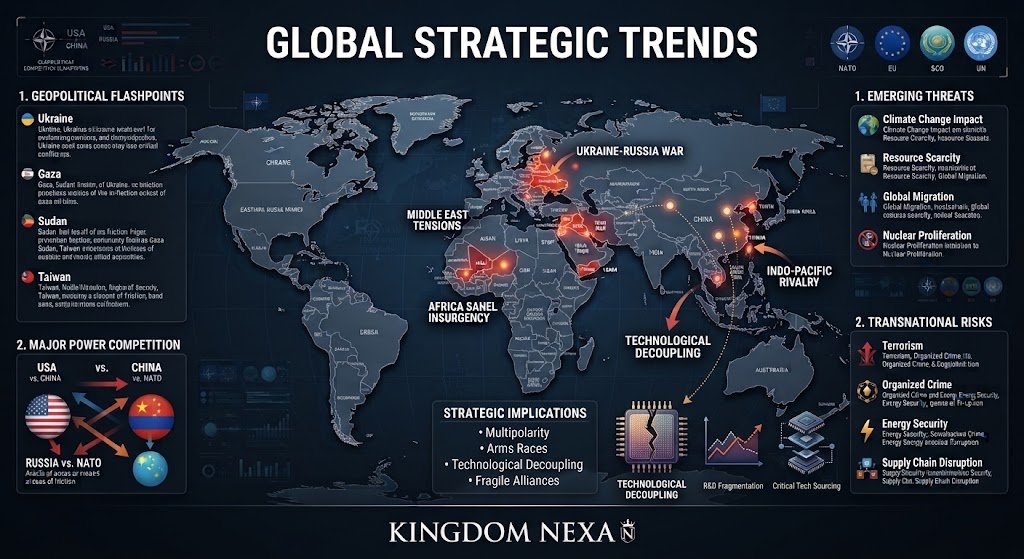
The combined effects of these developments are more important than any individual trend.
| Strategic trend | Principal implication |
|---|---|
| Multipolarity | More diverse partnerships, but less predictable alignment |
| Great-power rivalry | Greater pressure on security policy and diplomacy |
| Economic fragmentation | Higher resilience in some sectors, with potential cost increases |
| Military modernization | New deterrence options and new escalation risks |
| AI and technological competition | Changes in productivity, security, and industrial advantage |
| Resource competition | Greater attention to critical minerals, energy, and water |
| Regional conflicts | Disruptions to trade, security, and humanitarian conditions |
| Climate and demographic change | Growing pressure on adaptation, public services, and economic planning |
| Institutional fragmentation | More difficult coordination on shared global challenges |
For governments, these changes require a broader concept of national security. Defense readiness remains important, but so do functioning infrastructure, fiscal capacity, secure digital systems, reliable energy supplies, and public trust.
For businesses, geopolitical analysis is becoming an essential part of risk management. Companies need to understand exposure to sanctions, trade restrictions, political instability, critical suppliers, and changing regulatory requirements.
For developing economies, the priority is to strengthen resilience while maintaining access to international markets, investment, technology, and development finance.
What Are the Most Likely Future Scenarios?
Forecasting international politics is inherently uncertain. The following scenarios are analytical possibilities, not predictions that any single outcome is inevitable.
Scenario 1: Managed strategic competition
Major powers continue competing in technology, defense, and trade while maintaining communication channels and cooperating on selected issues such as financial stability, public health, and climate risks.
This outcome would require political restraint, effective crisis management, and recognition that some global challenges cannot be resolved by individual states acting alone.
Scenario 2: Deeper geopolitical fragmentation
Trade restrictions expand, technology ecosystems become less compatible, and states increasingly organize economic and security relationships around competing strategic partnerships.
This could strengthen resilience within selected blocs but raise costs, reduce economic efficiency, and limit opportunities for countries that depend on multiple international markets.
Scenario 3: Renewed pragmatic cooperation
Rising economic costs, shared security concerns, and pressure from domestic constituencies encourage governments to rebuild selected forms of international cooperation.
Such cooperation would not eliminate strategic rivalry. It could instead produce practical agreements in areas where the benefits of coordination outweigh the political costs.
Scenario 4: Escalation through interconnected crises
A regional conflict, cyber incident, energy shock, or technological disruption triggers wider economic and security consequences. Poor communication and retaliatory measures could amplify the initial crisis.
The probability and severity of such an outcome depend on circumstances that cannot be forecast with certainty. Strong institutions, diversified supply chains, credible deterrence, and functioning diplomatic channels can help reduce vulnerability.
How Should Governments and Businesses Prepare?
Monitoring global developments is useful, but strategic preparedness requires turning information into decisions.
Governments should diversify essential imports, invest in infrastructure and technological capabilities, maintain credible defense forces, and strengthen diplomatic relationships. They should also distinguish genuine security threats from risks that can be managed through regulation or cooperation.
Businesses should map critical suppliers, test alternative logistics routes, evaluate exposure to sanctions and trade restrictions, and develop contingency plans for energy, technology, and financing disruptions.
Researchers and analysts should compare multiple sources, distinguish evidence from interpretation, and update assumptions when new information becomes available. Scenario planning is generally more useful than relying on a single forecast.
Students and informed citizens should develop a working understanding of international relations, political economy, military strategy, technology, and international law. These fields increasingly overlap in the decisions that shape global affairs.
The most effective preparation combines flexibility with clear priorities. No government or organization can eliminate geopolitical uncertainty, but it can reduce unnecessary exposure and improve its capacity to respond.
Frequently Asked Questions About Global Strategic Trends
1. What are the main global strategic trends in 2026?
Major trends include multipolarity, US–China strategic competition, economic fragmentation, military modernization, AI competition, energy and critical-mineral security, regional conflicts, middle-power diplomacy, climate pressures, and challenges to global governance.
2. Why are global strategic trends important?
They help explain how long-term changes affect national security, economic growth, international trade, diplomacy, investment, and regional stability. Understanding them allows policymakers and businesses to anticipate risks rather than react only after a crisis occurs.
3. Is the world becoming multipolar?
Influence is becoming more distributed across several major and regional powers, but the transition is uneven. The United States and China retain substantial advantages, while other states exercise varying degrees of influence depending on the issue and region.
4. How does US–China competition affect other countries?
It can influence technology access, tariffs, investment, defense partnerships, supply chains, and diplomatic choices. Countries may gain opportunities from supply-chain diversification but also face pressure to align with competing strategic priorities.
5. What role does artificial intelligence play in geopolitics?
AI affects economic productivity, military planning, intelligence analysis, cybersecurity, and technological competitiveness. Countries with strong computing infrastructure, research capabilities, skilled workers, and reliable energy may gain advantages, although adoption also creates governance and security risks.
6. How do global strategic trends affect developing countries?
Developing countries may attract investment as supply chains diversify, gain new technology partnerships, and increase their diplomatic influence. However, they can also face debt pressures, volatile commodity prices, restricted market access, and higher costs from geopolitical fragmentation.
7. Are military spending increases making the world less secure?
Not necessarily in every case. Defense spending can strengthen deterrence and protect national interests, but rapid arms competition may increase threat perceptions, strain public finances, and raise escalation risks. The overall effect depends on strategic context and how military capabilities are used.
8. How do climate change and resource scarcity affect international relations?
Climate-related hazards and resource pressures can influence food prices, water management, migration, infrastructure, and regional cooperation. They may intensify existing tensions, but effective institutions and agreements can help states manage shared resources peacefully.
9. What is the difference between geopolitical trends and geopolitical events?
A geopolitical event is a specific occurrence, such as a treaty signing, election, or military confrontation. A geopolitical trend is a broader pattern that develops over time, such as technological rivalry, changing alliances, or the diversification of global supply chains.
10. How can analysts monitor global strategic trends effectively?
They should combine reliable government and international-organization data with academic research, established news reporting, and regional expertise. They should also monitor changes over time, compare competing explanations, and separate verified developments from forecasts and assumptions.
Conclusion
Global Strategic Trends reveal an international system undergoing profound but uneven transformation. Power is becoming more distributed, competition increasingly extends into technology and economic policy, military capabilities are evolving, and environmental and demographic pressures are creating additional strategic challenges.
Yet these developments do not point to one predetermined future. Multipolarity can create diplomatic opportunities as well as instability. Economic interdependence can generate vulnerabilities while providing incentives for cooperation. Technological innovation can strengthen national capabilities but also introduce new risks.
The decisive factor will be how governments, institutions, businesses, and societies respond to these pressures. Countries that combine economic resilience, technological capability, credible security policies, and effective diplomacy will be better positioned to navigate uncertainty.
For anyone studying international geopolitics and global affairs, the essential lesson is that strategic trends should be examined together rather than in isolation. Understanding their interaction provides a stronger basis for interpreting current events, assessing emerging risks, and making informed decisions about the future of the international system.