Introduction
The twenty-first century has transformed how nations compete for power, protect their interests, and influence the international system. Military strength remains important, but economic interdependence, artificial intelligence, energy security, digital infrastructure, climate change, and strategic supply chains have become equally significant dimensions of international politics. At the same time, regional conflicts and intensifying rivalry among major powers are testing the institutions established to maintain global stability.
Twenty First Century Geopolitics describes the evolving relationship between geography, political power, economic influence, technology, and international security in an increasingly interconnected world. The United States remains a leading global power, China has emerged as a major strategic competitor, India is expanding its influence, and regional powers are seeking greater independence in their foreign policies. Meanwhile, international institutions face pressure to adapt to challenges that extend beyond national borders.
The World Economic Forum’s Global Risks Report 2026 identifies geoeconomic confrontation as the leading risk most likely to trigger a global crisis in 2026. Its findings reflect concerns about economic coercion, strategic rivalry, and the weakening of international cooperation.
Understanding these developments requires historical perspective, careful analysis of national interests, and an appreciation of uncertainty. This article examines the forces shaping twenty-first-century geopolitics, their global consequences, and the possible directions of the international order.
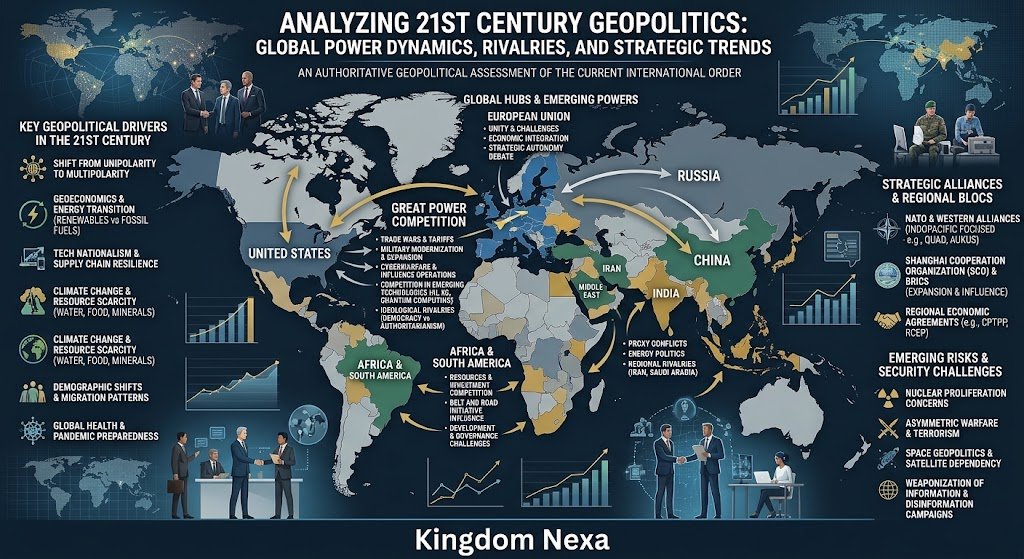
Infographic: The Main Forces Shaping Twenty-First-Century Geopolitics
The following visual framework summarizes the central forces influencing global power: multipolarity, great-power competition, technological transformation, economic interdependence, climate pressures, military security, non-state actors, and international governance.
Historical Evolution: From the Cold War to a Connected World
Modern geopolitics has developed through several major historical turning points. Understanding these changes helps explain why today’s international system combines deep economic connections with growing strategic rivalry.
The post-Cold War order
The dissolution of the Soviet Union in 1991 left the United States with an exceptionally influential global position. Trade liberalization, expanding financial networks, and technological advances accelerated globalization. China subsequently became a major manufacturing and trading power, while regional economies became more closely connected.
The shocks of the twenty-first century
The terrorist attacks of September 11, 2001, redirected international security priorities toward counterterrorism. The 2008 global financial crisis exposed vulnerabilities in international financial systems and challenged assumptions about economic stability.
During the 2010s, China’s growing influence, Russia’s confrontation with Western governments, regional conflicts, and disputes over digital technology intensified strategic competition.
The COVID-19 pandemic exposed vulnerabilities in global supply chains. Russia’s full-scale invasion of Ukraine in February 2022 renewed attention to territorial sovereignty, military deterrence, energy security, and European defence.
By 2026, the international order is neither a straightforward return to Cold War bipolarity nor a fully established multipolar system. Power is distributed unevenly across military, economic, technological, and diplomatic domains.
Major Actors and Their Geopolitical Interests
The international system is shaped by countries with different capabilities, ambitions, and domestic constraints.
United States
The United States seeks to preserve its global influence, maintain alliances, protect access to strategic markets, and sustain technological leadership. Its extensive military partnerships and financial influence remain important advantages.
However, domestic political divisions, fiscal pressures, and competing international commitments can constrain policy choices.
China
China’s priorities include economic development, technological advancement, regional security, and greater influence in international affairs. Its manufacturing capacity and position in global supply chains provide considerable leverage.
At the same time, demographic pressures, economic imbalances, strategic mistrust, and tensions in the Indo-Pacific complicate its ambitions.
European Union
The European Union seeks economic competitiveness, regional security, energy resilience, and greater strategic autonomy. Its commercial market and regulatory influence are important sources of international power.
Internal policy differences and the challenge of coordinating defence and foreign policy can limit collective action.
India and other emerging powers
India seeks economic growth, strategic independence, regional influence, and stronger international representation. Its relationships with Western countries, Russia, and other Asian partners reflect a preference for maintaining room to manoeuvre.
Other influential actors include Brazil, Indonesia, Türkiye, Saudi Arabia, South Africa, Japan, Australia, and South Korea. Their priorities differ, but each can affect regional trade, security, technology, or diplomacy.
Middle powers and strategic flexibility
Middle powers often pursue different partnerships for different purposes rather than aligning completely with one major power. This approach can increase bargaining power, but it requires careful diplomacy and a clear understanding of national interests.
Economic Interdependence and Geoeconomic Competition
Economic relationships have become both sources of prosperity and instruments of strategic influence. Governments increasingly assess trade, finance, industrial capacity, and supply chains through a national-security lens.
Trade, sanctions, and strategic dependencies
Tariffs, sanctions, export controls, and investment restrictions can be used to influence the behaviour of other states. Their effectiveness depends on international coordination, enforcement, and the target country’s ability to find alternatives.
However, excessive restrictions can increase production costs, disrupt businesses, and provoke retaliation. Economic coercion may therefore produce unintended consequences for the countries imposing restrictions as well as those targeted.
Critical minerals and energy security
Lithium, copper, nickel, graphite, and rare earth elements are important to various energy, electronics, transport, and defence technologies. Countries that control processing capacity or specialised manufacturing can gain influence even when they do not possess the largest natural reserves.
Oil and natural gas remain strategically significant, while renewable energy, electricity grids, batteries, and nuclear power are changing long-term energy calculations.
Opportunities for developing economies
Supply-chain diversification may attract manufacturing investment to developing economies. Yet these opportunities depend on reliable electricity, efficient ports and roads, skilled labour, stable institutions, and predictable regulation.
For countries such as Pakistan, improving economic resilience and expanding trade opportunities can strengthen diplomatic flexibility. Geographic location alone does not guarantee influence; infrastructure, financial stability, and effective policy determine whether a country can convert location into lasting economic benefits.
Technology and the New Geopolitical Frontier
Technological capabilities are increasingly important to national power because they influence economic productivity, intelligence, military effectiveness, and access to information.
Artificial intelligence and semiconductors
Advanced chips enable AI systems, scientific research, communications, and sophisticated military applications. Competition over semiconductor design, manufacturing equipment, computing infrastructure, and technical expertise has therefore become a strategic concern.
AI may improve logistics, intelligence analysis, cybersecurity, and public services. It can also enable surveillance, facilitate disinformation, and introduce new risks when automated systems are used in high-stakes decisions.
Technological leadership requires more than invention. Countries also need skilled workers, reliable energy, research funding, industrial capacity, and appropriate safeguards.
Cybersecurity and digital sovereignty
Governments and businesses increasingly depend on cloud platforms, telecommunications networks, satellites, and interconnected infrastructure. Disruption to these systems can affect financial transactions, transport, electricity, and public administration.
Digital sovereignty refers to a state’s capacity to govern its digital infrastructure, data, and technology dependencies. It does not necessarily require technological isolation. Diversifying suppliers, improving cybersecurity, and establishing clear legal protections can reduce vulnerability while preserving international cooperation.
Space and autonomous systems
Satellites support navigation, weather forecasting, communications, intelligence, and military operations. Their strategic importance creates incentives to protect space infrastructure while increasing concerns about interference and militarization.
Drones and autonomous systems are also changing warfare by expanding surveillance, reducing some operational costs, and enabling attacks at greater distances. Their spread creates challenges for defence planning, escalation management, and international regulation.
Military Security and Strategic Rivalry
Military power remains a core element of twenty-first-century geopolitics, but its effectiveness increasingly depends on the integration of conventional forces, cyber capabilities, intelligence, logistics, industrial production, and advanced technology.
According to the Stockholm International Peace Research Institute (SIPRI), global military expenditure reached $2.887 trillion in 2025, an increase of 2.9% in real terms from 2024. It was the eleventh consecutive year of growth.
This trend reflects continuing conflicts, perceived security threats, military modernization, and changing defence commitments. Yet higher expenditure does not automatically produce better strategic outcomes. Military effectiveness also depends on training, maintenance, leadership, industrial capacity, and political objectives.
Nuclear deterrence remains particularly consequential. States with nuclear weapons must manage the risks of miscalculation, escalation, and declining confidence in arms-control arrangements.
Regional conflicts also demonstrate that conventional military operations can generate wider economic and diplomatic effects. Disruption to shipping, energy supplies, or agricultural exports may affect countries far removed from the battlefield.
Regional Dynamics Across the World
Twenty-first-century geopolitics cannot be understood solely through relations between Washington and Beijing. Different regions have their own strategic interests, historical disputes, and sources of influence.

Indo-Pacific
The region is central to strategic competition because of its maritime routes, industrial networks, and military significance. Taiwan, the South China Sea, and the security relationships of Japan, Australia, India, and Southeast Asian countries will continue to influence regional stability.
Europe
Russia’s war against Ukraine has reshaped defence planning, energy policy, and debates about European strategic autonomy. NATO, the EU, and national governments face the challenge of strengthening security while sustaining economic resilience.

Middle East
Energy markets, maritime chokepoints, regional rivalries, armed conflicts, and diplomatic realignment make the region strategically important. Outcomes depend on local actors as well as the interests of external powers.

Africa
Critical minerals, infrastructure finance, population growth, food security, and regional integration create major opportunities and challenges. African governments seek investment and partnerships while managing debt, conflict, and development pressures.

Latin America
Food production, energy, minerals, migration, and the Amazon’s environmental significance shape regional and global interests. Governments must balance external investment with domestic development and environmental priorities.
These regional dynamics overlap. Competition for minerals in Africa, manufacturing in Asia, energy in the Middle East, and technology in Europe and North America connects local decisions to wider global power relationships.
International Institutions, Law, and Global Governance
International institutions were established to support cooperation, reduce conflict, and create common rules. Their importance has not disappeared, but their ability to address contemporary challenges is increasingly contested.
The United Nations provides a forum for diplomacy and international security. However, divisions among permanent members of the Security Council can obstruct collective action.
NATO supports collective defence among its members. The European Union combines economic integration with diplomatic and regulatory influence, while the World Trade Organization provides a framework for trade rules. The IMF and World Bank play important roles in financial cooperation and development.
On September 22, 2024, UN member states adopted the Pact for the Future, alongside the Global Digital Compact and the Declaration on Future Generations. These agreements address international peace and security, sustainable development, digital cooperation, and global governance. Their practical impact depends on implementation and political commitment.
International law also remains relevant to sovereignty, territorial disputes, maritime rights, and the conduct of armed conflict. The UN Charter establishes fundamental rules on the use of force, while international humanitarian law governs the treatment of civilians and other protected persons during war.
A central challenge is the gap between legal commitments and enforcement. Consistent application of international law, credible dispute-resolution mechanisms, and sustained diplomacy are essential to maintaining confidence in the international system.
Domestic Politics and the Influence of Non-State Actors
Foreign policy is shaped not only by external threats but also by elections, economic performance, public opinion, national identity, and political institutions.
Economic hardship may increase opposition to trade agreements or overseas commitments. Nationalist movements can influence territorial disputes, while leadership changes may alter alliance priorities. These domestic pressures can make international agreements harder to negotiate and sustain.
Non-state actors also shape the international environment:
- Multinational corporations influence investment, manufacturing, employment, and supply chains.
- Technology companies affect digital infrastructure, AI development, and data governance.
- Civil society organizations contribute to humanitarian assistance, environmental advocacy, and accountability.
- Armed groups and criminal networks can destabilize regions and complicate peace negotiations.
- Media and research institutions influence public understanding of international events, while misinformation can undermine trust.
Governments must balance security with economic innovation, public accountability, and civil liberties. Their ability to manage these competing priorities can influence national resilience and international credibility.
Major Risks and Challenges Ahead
Several interconnected threats could undermine global stability during the coming decades.
- Great-power conflict: Miscalculation, military incidents, and competing security commitments could trigger wider confrontation.
- Economic fragmentation: Trade restrictions and competing technology systems could disrupt markets and increase costs.
- Nuclear escalation: Weakening arms-control arrangements and declining strategic trust could increase catastrophic risks.
- Cyberattacks and misinformation: Digital disruption can damage infrastructure, distort public debate, and complicate crisis response.
- Climate and resource insecurity: Food shortages, water stress, and extreme weather can aggravate existing political vulnerabilities.
- Institutional weakness: International organizations may struggle to respond when powerful states disagree.
- Debt and development pressures: Financial instability can constrain public services and increase exposure to external shocks.
These risks can reinforce one another. For example, a regional conflict may disrupt shipping, raise energy prices, trigger sanctions, and intensify domestic political pressure in distant countries.
The World Economic Forum’s 2026 assessment highlights the interconnected nature of these threats, including geoeconomic confrontation, interstate conflict, misinformation, and technological risks. These are assessments of potential danger, not predictions that every risk will materialize.
Three Possible Scenarios for the Future
The international order will depend on political decisions, economic conditions, technological change, and the ability of governments to manage crises. Three scenarios illustrate plausible directions.
Scenario 1: Fragmented multipolarity
Major powers strengthen competing economic and security networks. International trade continues, but strategic industries become increasingly divided, and institutions struggle to coordinate responses to crises.
Countries may gain flexibility by diversifying partnerships, but smaller economies could face greater pressure to align with competing blocs.
Scenario 2: Competitive coexistence
Strategic rivalry persists, but governments establish practical limits on confrontation. They maintain deterrence while negotiating on nuclear risks, maritime incidents, trade, and selected global challenges.
This scenario would not eliminate distrust. It would instead make competition more predictable through diplomacy, communication channels, and limited agreements.
Scenario 3: Renewed international cooperation
Governments recognize that climate change, nuclear risks, pandemics, and technological threats cannot be managed independently. They strengthen international institutions and negotiate workable standards for shared challenges.
This outcome would require sustained political commitment, resources, and compromises among states with different interests.
The eventual international system may combine elements of all three scenarios. Cooperation could strengthen in one policy area even while competition intensifies elsewhere.
Frequently Asked Questions (FAQs)
1. What is twenty-first-century geopolitics?
Twenty-first-century geopolitics examines how geography, military power, economics, technology, and diplomacy shape relations among states and non-state actors in the modern international system.
2. How is modern geopolitics different from traditional geopolitics?
Traditional geopolitics emphasized territory, military strength, natural resources, and strategic location. Modern analysis also considers digital infrastructure, global supply chains, AI, financial networks, climate change, and technological dependencies.
3. Which countries are most influential in twenty-first-century geopolitics?
The United States and China remain central powers, while India, Russia, major European states, and regional actors such as Türkiye, Saudi Arabia, Brazil, and Indonesia influence specific global and regional outcomes.
4. Why is the Indo-Pacific so important?
The Indo-Pacific contains major shipping routes, manufacturing networks, and strategically significant maritime areas. Competition involving China, the United States, Taiwan, India, Japan, and other regional actors affects global security and trade.
5. How does technology affect geopolitical power?
AI, semiconductors, satellites, cyber capabilities, and advanced manufacturing influence military effectiveness, economic productivity, intelligence, and communications. Access to critical technologies can create both advantages and dependencies.
6. What is geoeconomic competition?
Geoeconomic competition occurs when governments use economic tools, including sanctions, tariffs, export controls, and investment restrictions, to advance strategic objectives or influence other countries.
7. Can international organizations prevent geopolitical conflict?
International organizations can facilitate diplomacy, establish rules, support peacekeeping, and coordinate responses to shared problems. Their effectiveness depends on political support, institutional authority, resources, and member-state cooperation.
8. How does climate change influence geopolitics?
Climate change affects water availability, food production, energy systems, infrastructure, and human security. These pressures can intensify existing disputes, although environmental stress does not automatically lead to conflict.
9. What can developing countries do to strengthen their geopolitical position?
Developing countries can diversify trade and diplomatic partnerships, improve infrastructure, strengthen institutions, invest in education and technology, and maintain sustainable public finances. These measures increase resilience and bargaining power.
Conclusion: Understanding a Changing International System
Twenty-first-century geopolitics is defined by the interaction of major-power competition, economic interdependence, technological transformation, regional conflicts, and shared global challenges. The distribution of influence is becoming more complex, but the future is not predetermined.
The United States and China will remain central to international competition, while India, the European Union, and other regional powers will help shape the emerging order. Technology, critical minerals, energy security, digital infrastructure, and resilient supply chains will increasingly influence national strategies.
At the same time, no country can independently resolve every challenge involving climate change, nuclear risks, global health, or economic instability. International institutions and diplomacy remain necessary, even when strategic rivalry makes cooperation difficult.
For governments, businesses, researchers, and citizens, understanding Twenty First Century Geopolitics means looking beyond immediate headlines to examine long-term interests, structural dependencies, and alternative outcomes. Countries that combine economic resilience, technological capability, effective institutions, and flexible diplomacy will be better prepared for uncertainty.
The central challenge is not simply to accumulate power, but to use it responsibly, manage competition, and preserve opportunities for international cooperation.